
Guide
How to Spot an Aircon Refrigerant Leak (Before You Pay for Another Top-Up)
Ice formation, oily residue at joints, gradual cooling loss and repeated top-ups all indicate a refrigerant leak. Here's how to spot the signs and what to do.
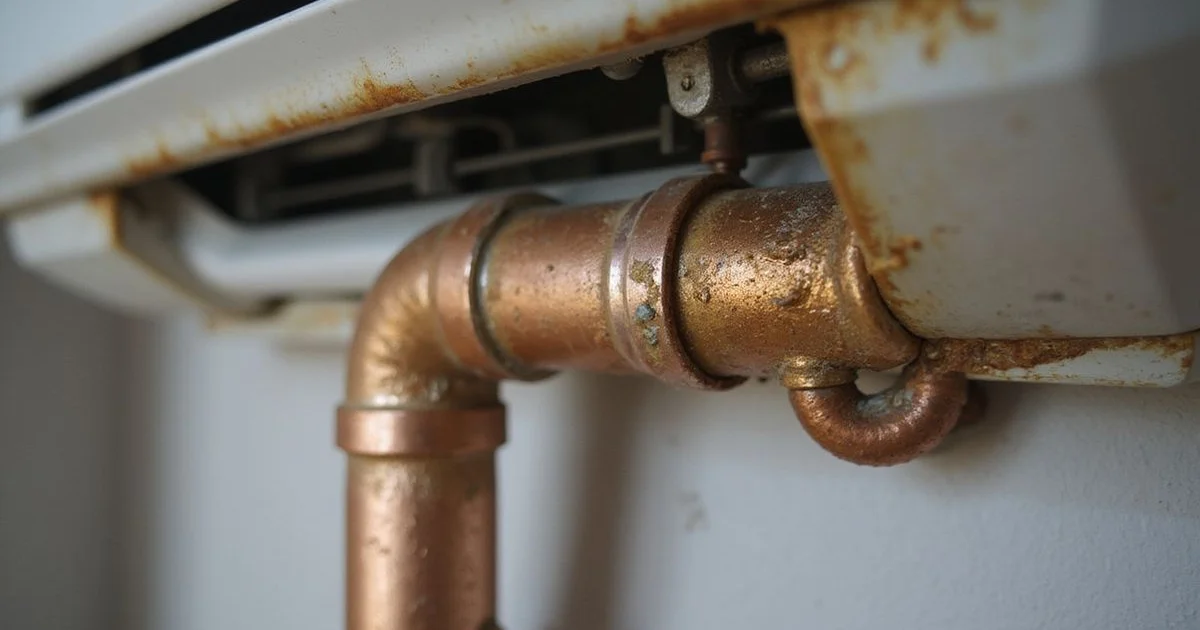
Four aircon refrigerant leak signs
It is a common myth that air conditioners simply consume their gas over time. In reality, refrigerant circulates indefinitely within a completely sealed copper loop, making it critical to recognise the actual aircon refrigerant leak signs.
We encounter this misconception daily during service routes across Cheras and the greater Selangor area. A healthy cooling system will never burn off its gas during normal operation.
If your system is suddenly running low, a physical breach is letting that chemical escape into the atmosphere.
Let’s review the four clearest indicators of a leak, identify exactly where they happen, and walk through the proper diagnostics needed to fix them.

Sign 1: Ice forming on copper pipes
A sudden drop in refrigerant pressure forces your evaporator coil to freeze solid. According to standard HVAC operating metrics, an indoor coil maintains a temperature of around 4.4°C to effectively cool the surrounding air.
Our technicians often find that when refrigerant escapes, this internal temperature plummets well below the freezing point. The high humidity in the local Selangor climate causes airborne moisture to immediately condense and freeze against the cold metal.
You will typically see this manifest as a thick white frost or solid ice forming on the exposed copper pipework. Checking the larger copper line running from the indoor blower to the outdoor compressor is the fastest way to confirm this issue.
Sign 2: Oily residue at joints or valves
Cooling gas travels alongside a specialised synthetic lubricant that leaves a slick residue when it escapes. Modern systems running on R32 gas typically use Polyolester or PVE oils to lubricate these moving parts.
We always advise property owners to look for a dark, slick residue pooling around the connection points. While the escaped gas instantly evaporates into the surrounding air, this sticky oil gets left behind on the metal surfaces.
Inspect the brass connection valves on the outdoor condenser unit for any greasy buildup. Wiping the metal with a clean cloth will quickly reveal if an active breach exists.
Key inspection spots for oil residue include:
- The large and small brass service valves outside.
- The connection nuts located behind the indoor blower.
- The copper U-bends exposed on the side of the condenser.
Sign 3: Gradual cooling loss
A slow chemical leak causes a steady and gradual decline in performance over several weeks or months. A system suffering from an electrical failure, like a blown capacitor, will stop producing cold air instantly.
Our typical residential service call usually begins after the customer notices they have to lower their thermostat further just to maintain basic comfort. Based on technical performance benchmarks, a healthy unit should create a noticeable temperature drop, blowing out air that is significantly cooler than the room’s ambient temperature.
This cooling capacity slowly degrades as the chemical volume drops.
| Timeframe | Cooling Performance Indicator |
|---|---|
| Month 1 | Barely noticeable difference, slight increase in operational runtime. |
| Month 2 | Air feels less crisp, and the room takes significantly longer to cool down. |
| Month 3 | Thermostat setpoint must be lowered drastically for minimal comfort. |
Sign 4: Repeated top-ups
Needing repeated gas refills within a few months is the most definitive proof that your system has a physical compromise. If a technician has added gas to the unit and pressure drops again, the chemical is actively escaping.
We constantly inform customers that quality factory-charged refrigerant should last the entire operational lifespan of the hardware. Local industry data shows that a well-maintained system in Malaysia generally lasts between 10 to 15 years without ever requiring a top-up.
Paying for repeated refills is essentially throwing money out the window while ignoring the root cause. Finding and sealing the exit point is the only permanent fix.
Where leaks typically occur
The physical stress placed on copper components makes brass flare joints the most common failure points. Knowing exactly where to find aircon leak points is half the battle.
We have identified very specific weak points across both residential and commercial setups during our 10+ years of gas top up work. Modern systems operating on R32 generate incredibly high pressures, making precise installation absolutely critical for longevity.
Here are the most common failure points local crews repair:
- Brass flare joints: These are the primary culprits at the outdoor unit. Manufacturer guidelines specify that a 1/4-inch copper line requires a precise tightening torque of 14 to 18 Newton-meters.
- Schrader valves: The internal pins on these service ports can degrade or get stuck after improper gauge handling.
- Coil pinholes: The high-moisture environment accelerates formicary corrosion, causing microscopic holes in the aluminium fins.
- Damaged copper: External forces like rodent chewing, aggressive renovation work, or poorly secured brackets will easily fracture soft copper lines.
Almost all of these structural failures are repairable in a single visit once the exact exit point is verified.
Professional leak detection
Locating a microscopic hole requires specialised diagnostic equipment like electronic sniffers or pressure testing. Confirming a pressure drop is relatively simple, but learning how to detect aircon leak sources with pinpoint accuracy demands professional tools.
We deploy industry-standard tools to isolate the exact source of the failure without tearing the property apart. Guesswork has no place in proper HVAC maintenance.
The most reliable diagnostics rely on three specific techniques:
- Electronic refrigerant detectors: According to SAE environmental testing standards, highly sensitive sniffer tools can detect gas escaping at a rate as low as 4 grams per year.
- Pressure-decay testing: Technicians will isolate the copper circuit and pressurise the lines with Oxygen-Free Nitrogen to watch for an absolute gauge drop.
- Fluorescent UV dye: For exceptionally slow seepage, a safe, UV-reactive fluid is injected into the loop to illuminate the exit point under a blacklight.
An experienced operator using these electronic sensors will usually pinpoint the fault within 15 minutes of methodical scanning.
What we don’t do
Ethical service practices mean we will never refill a dry system repeatedly without investigating the hardware failure.
We refuse to engage in the predatory tactics that have unfortunately become common in the local repair industry. Your trust is far more valuable than a quick service fee.
These are the specific practices the team absolutely avoids:
- Refilling a system multiple times without verifying the structural integrity of the copper lines.
- Quoting a standard top-up price while privately knowing the pressure will drop again next month.
- Pressuring property owners into expensive diagnostics when a basic visual inspection has already identified the fault.
Our commitment to transparent service means the daily operation looks very different from the industry average:
- Technicians check the baseline pressure first and proceed with a refill only if it makes logical sense for the hardware.
- The team will provide an honest assessment if your decade-old unit is simply too corroded or expensive to justify repairing.
- Staff members explain the exact risks upfront if a temporary gas charge might not hold long-term.
That straightforward approach is the exact reason this business has built such strong reviews across the Cheras and Selangor region.
Understanding these aircon gas leak signs can save your compressor from total failure.
If you suspect your cooling system is compromised, contact the support team to schedule a proper diagnostic check today.
Related reading: For the next step, book our aircon gas top up team, or read our guide on R32 vs R410A vs R22: Aircon Refrigerant Gases Explained.