
Guide
R32 vs R410A vs R22: What Refrigerant Does Your Aircon Use?
R32 is the newest and most efficient. R410A is mid-age. R22 is being phased out for environmental reasons. Here's why the type matters for top-ups and replacement.
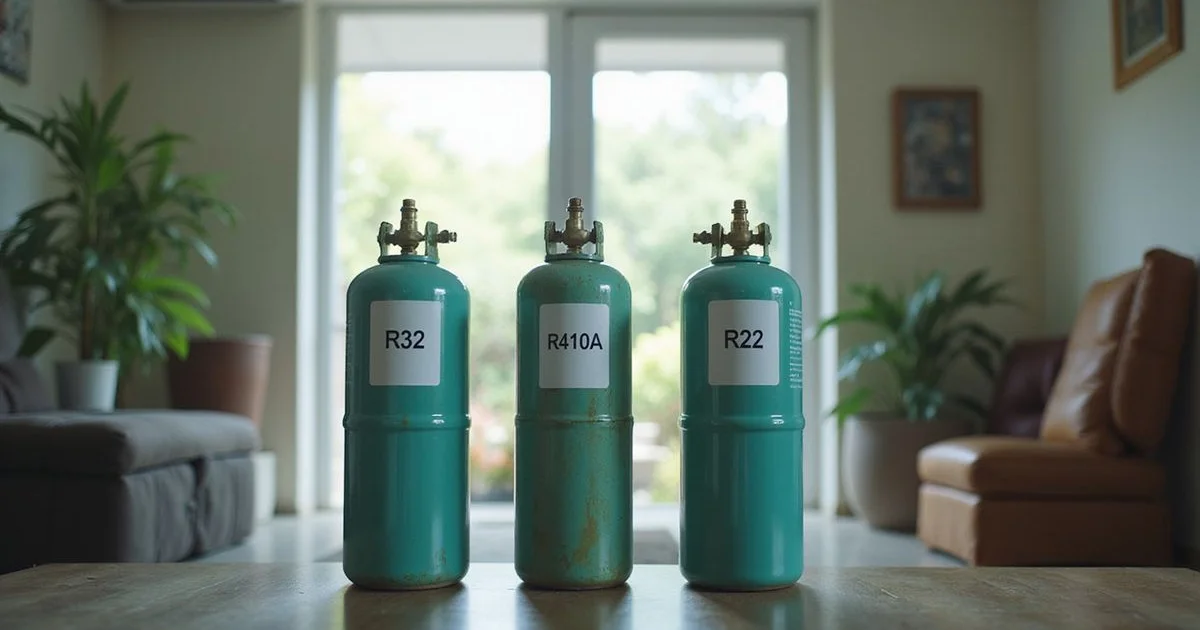
Three refrigerants in Malaysian homes: r32 vs r410a vs r22 aircon
Our team services hundreds of properties across Cheras and Selangor, revealing a consistent truth about cooling systems. The specific gas inside your compressor dictates long-term maintenance costs far more than the brand name itself, making the choice of r32 vs r410a vs r22 aircon systems a crucial detail.
We always check this technical detail first before quoting a job.
Every property owner must understand their system’s requirements before scheduling a gas top up or approving a major repair. Market data from 2026 indicates local homes rely heavily on three distinct aircon refrigerant types.
R32: the modern choice
If you want the r32 refrigerant explained simply, it is the highly efficient standard found in almost all new inverter air conditioners installed across Malaysia since 2020. This single-component gas dominates the modern market for very clear, measurable reasons.
Our technicians prefer working with this gas because it requires up to 25% less charge volume than older alternatives. Lowering the physical volume inside the system reduces the strain on the mechanical components.
We frequently see these units delivering a 10% to 30% reduction in electricity consumption compared to legacy systems. The environmental metrics also justify the widespread adoption.
R32 carries a Global Warming Potential (GWP) of just 675, which is roughly one-third the climate impact of older options. If your unit was installed within the last five years, it almost certainly uses this modern standard.
Our service trucks carry ample supplies of this refrigerant for straightforward, fast maintenance. Every new Daikin or Panasonic inverter unit sold locally today utilizes this highly efficient option.
- Superior heat transfer: The physical properties cool rooms faster while consuming less power.
- Lower environmental impact: The 675 GWP rating meets strict international climate agreements.
- Widespread availability: The Malaysian market is fully saturated with affordable replacement supplies.
- Single-component stability: It does not separate into different chemical parts during a leak.
R410A: the mid-age standard
R410A served as the primary bridge refrigerant before R32, acting as the global standard for installations roughly between 2010 and 2020. It replaced earlier ozone-depleting chemicals but still carries a much higher Global Warming Potential of 2088.
Our teams still encounter this gas daily in homes throughout the Klang Valley. The chemical composition is actually a 50/50 blend of difluoromethane and pentafluoroethane.
We find that most mid-aged units running this blend remain perfectly serviceable. Local suppliers continue to stock plenty of inventory, meaning regular maintenance causes no logistical headaches.
Our recommendation for an eight-year-old system is simply to keep it clean and properly charged. There is absolutely no regulatory urgency to replace functional equipment solely because it runs on this specific blend.
Key Differences: R32 vs R410A
| Feature | R32 | R410A |
|---|---|---|
| Composition | Single pure gas | 50/50 Chemical blend |
| Global Warming Potential | 675 (Low) | 2088 (High) |
| Energy Efficiency | High (reduces bills by 10% to 30%) | Moderate |
| Market Status | Current standard | Phasing down slowly |
R22: being phased out
R22 was the industry standard for decades, but it is now strictly regulated and actively being eliminated. The r22 phase out malaysia program, gazetted under the Environmental Quality Regulations in 2020, mandates a target of zero R22 utilization by 2030.
Our company strictly adheres to these national guidelines. Manufacturing or assembling new equipment using this ozone-depleting substance is already banned locally.
We actively advise clients against pouring money into these aging systems. The available commercial stock is dwindling rapidly, causing the per-kilo replacement price to climb every year.
Our technicians often find that major repairs on these units simply do not make financial sense anymore. What limited inventory remains in the country is all that will ever be available.
If you own a system exceeding ten years old, planning a full replacement is the smartest financial move.
- Severe regulatory limits: The 2030 zero-utilization target forces a complete transition.
- Climbing maintenance costs: Scarcity drives the price of basic recharges higher every season.
- Ozone depletion risks: The chemical makeup actively damages the earth’s protective atmospheric layer.
- Obsolete technology: Parts for these older fixed-speed compressors are increasingly rare.
How to check which refrigerant your aircon uses
You will find the exact gas type printed clearly on the manufacturer’s nameplate attached to the chassis. This small metal or foil sticker usually sits on the side panel of the outdoor condenser or under the indoor unit’s cover.
Our dispatchers always ask for a quick photo of this label during the initial consultation. Look specifically for the words “Refrigerant”, “R-Type”, or “Factory Charge”, followed by the alphanumeric code.
We use this critical information to load the correct supplies onto the truck before leaving the depot. Confirming the details in advance prevents delays and guarantees an accurate price quote.
Pro Tip: If the sticker is faded from the sun, search the exact model number online. A quick check of the brand’s digital manual will instantly confirm the factory specifications.
Why mixing refrigerants is a bad idea
Blending different cooling gases instantly damages the compressor and completely voids the manufacturer’s warranty. Every system is engineered for a specific chemical density, pressure ratio, and compatible lubrication oil.
Our diagnostic tools easily detect when a system contains contaminated or mixed gases. Introducing R410A into an R32 system alters the physical properties and reduces the required lubrication quality.
We have seen compressors fail within hours of an improper recharge. R32 is classified as a mildly flammable A2L substance, while R410A is a non-flammable A1 blend.
Our safety protocols forbid topping up a system without verifying the original chemical makeup. Mixing these drastically different classifications violates safety standards and creates unpredictable pressure spikes inside the copper lines.
If a previous contractor used the wrong product, the entire line requires a complete vacuum flush. Refilling the unit properly from scratch is the only way to restore safe, reliable operation.
The Dangers of Cross-Contamination
- Immediate warranty cancellation: Brands like Daikin void coverage the moment incorrect fluids are detected.
- Lubrication breakdown: Incompatible synthetic oils cause the mechanical pistons to overheat and seize.
- Severe safety hazards: Altering the flammability classification creates dangerous operating conditions.
- Plummeting efficiency: The mismatched pressure ratios force the motor to work twice as hard for less cooling.
What this means for repair-or-replace
The specific chemical running through your lines heavily dictates whether a major repair makes practical financial sense. We utilize a straightforward evaluation framework based on the age of the hardware and the availability of the required gas.
Understanding these guidelines protects you from investing in dead technology. Our team shares this matrix with every client to ensure complete transparency before starting any expensive work.
The exact tipping point always depends on the quoted repair cost and the general mechanical condition. We generally suggest saving modern equipment and retiring units that rely on obsolete chemicals.
The refrigerant type is an essential factor in that final calculation.
The Repair vs. Replace Matrix
| Unit Gas Type | Age of Equipment | Recommended Action | Financial Justification |
|---|---|---|---|
| R32 | Any age | Repair | High efficiency and cheap, abundant gas supplies. |
| R410A | Under 8 years | Repair | Parts are common and the blend remains widely supported. |
| R22 | Under 5 years | Evaluate | Only makes sense for minor fixes due to climbing gas prices. |
| R22 | Over 8 years | Replace | 2030 phase-out and scarce stock make repairs uneconomical. |
Conclusion
Understanding the differences between r32 vs r410a vs r22 aircon systems helps you make profitable maintenance decisions. The correct repair strategy relies entirely on identifying the exact chemical inside your condenser.
Our licensed technicians handle, recover, and refill all local cooling gases safely.
Schedule a fast inspection with the team today to ensure your property stays perfectly chilled all year long.
Related reading: Still deciding? You can also read our guide on How to Spot an Aircon Refrigerant Leak.