
Guide
What Size (HP) Aircon Do I Need for My Room?
HP-to-room-size guide for typical Malaysian homes, with adjustments for ceiling height and sun exposure. Why over-sizing wastes energy and under-sizing fails to cool.
Why getting HP right matters
We observe the same critical mistake daily across Cheras and Selangor during residential cooling projects. People buy a new unit based purely on gut feel, assuming a bigger room automatically needs the largest available unit. If you are wondering what hp aircon for room size you actually need, that guesswork approach ignores the science of thermal loads and leads straight to wasted money.
Sizing properly takes just a few minutes during an aircon installation assessment.
Our initial calculation ensures your system runs efficiently for years. Getting this exact balance right is what separates a comfortable, dry room from a clammy space plagued by mold.
According to 2025 industry data, a well-maintained air conditioner compressor should last 12 to 15 years. A poorly sized unit short-cycles and stresses those internal components, cutting that lifespan drastically. Let’s look at the baseline numbers for Malaysian homes, examine the three critical adjustment variables, and show you exactly why going too big or too small fails.
The HP-to-room-size baseline
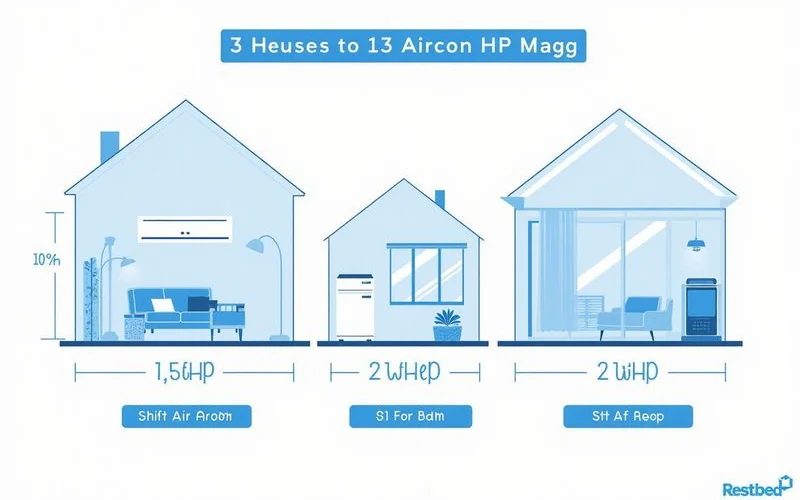
Our baseline calculations rely on a standard formula matched to typical Malaysian room dimensions. The minimum requirement for a standard bedroom is a 1.0HP unit, while large living spaces need 2.0HP or more.
These starting points assume a standard ceiling height of 2.7 to 3.0 metres and moderate sun exposure. Modern terraced houses in areas like Bandar Mahkota Cheras typically fit right into these standard metrics.
| Room Size (sq ft) | Typical Room Type | Recommended HP |
|---|---|---|
| Up to 100 sq ft | Small bedroom, study | 1.0HP |
| 100 to 150 sq ft | Medium bedroom | 1.5HP |
| 150 to 200 sq ft | Master bedroom, small living | 1.5HP to 2.0HP |
| 200 to 300 sq ft | Large living, dining | 2.0HP to 2.5HP |
| 300+ sq ft | Open-plan, large hall | 2.5HP+ or multi-unit |
This aircon hp guide gives you a solid foundation for planning. These figures serve as the benchmark for aircon sizing malaysia professionals rely on.
We adjust these base numbers up or down based on three specific environmental factors. Every property presents unique thermal challenges that require slight modifications.
Adjustment 1: Ceiling height
Ceilings higher than the standard 2.7 metres require additional cooling capacity to handle the increased air volume. We automatically size up by half a horsepower for lofts, mezzanines, or older shophouses with high clearance.
The physics behind this are straightforward. A room with 3.5-metre ceilings holds significantly more air than the same floor area built to the standard 2.7-metre specification.
Each 0.5 metres above standard adds roughly 10% to 15% to your total cooling load. This extra volume demands a unit capable of circulating cold air all the way to the floor, overcoming the natural tendency for warm air to rise and accumulate near the roof.
Adjustment 2: Sun exposure
Rooms facing west or south-west in Malaysia absorb intense afternoon solar radiation, requiring a larger aircon. Our standard practice is to increase the unit size by one full HP step for spaces with unshaded windows facing the afternoon sun.
Direct sunlight dramatically alters indoor surface temperatures. Glass windows without a low-emissivity (Low-E) coating act like magnifying glasses for thermal gain, trapping heat inside the concrete walls.
For shaded interior rooms with no direct sun exposure, the opposite rule applies. You can safely size down in those protected spaces without losing any comfort.
Adjustment 3: Occupancy and use
Every person and electronic device in a room generates heat, meaning crowded spaces require more cooling capacity. We calculate this additional load based on how the room will actually be utilised daily.
The human body at rest outputs roughly 250 to 400 BTU per hour. A four-person bedroom needs significantly more cooling power than a single-occupancy room of the exact same size.
Other common heat sources require careful calculation:
- Kitchens: Regular cooking heat from stoves and ovens adds massive thermal stress.
- Home Offices: High-end desktop computers and multiple monitors can easily add 1,000 BTU/hr to the room.
- Entertainment Rooms: Large televisions, gaming consoles, and amplifiers produce steady radiant heat.
BTU basics (the underlying math)
Horsepower (HP) is simply a retail shorthand for British Thermal Units (BTU), which measures the actual cooling energy. You need roughly 600 BTU per square metre of floor space to properly cool a standard room in Malaysia.
Our technicians rely on these exact BTU conversion rates when planning commercial or residential layouts. Understanding this math explains why simply buying the biggest unit available is a flawed strategy.
| Retail Horsepower | Cooling Capacity |
|---|---|
| 1.0HP | ~9,000 BTU/hr |
| 1.5HP | ~12,000 BTU/hr |
| 2.0HP | ~18,000 BTU/hr |
| 2.5HP | ~24,000 BTU/hr |
This 600 BTU per square metre rule serves as our primary anchor before applying the adjustments for height, sun, and occupancy. You never have to calculate these formulas yourself, but knowing the metrics helps you make an informed purchase.
Why oversizing fails
Buying an oversized aircon causes the unit to reach the target temperature too fast, completely failing to remove humidity from the air. This rapid cooling and shutting off is known as short-cycling, and it leaves your room feeling cold but uncomfortably clammy.
We constantly fix issues in homes where massive units run for only five minutes before shutting down. Malaysia’s average relative humidity hovers between 70% and 90% year-round. An air conditioner needs sustained run times of at least 15 to 20 minutes to properly condense and drain that airborne moisture.
Common signs of an oversized aircon include:
- Musty, damp odours lingering in the room.
- A clammy feeling on your skin despite the cold air.
- Frequent, loud clicking as the compressor turns on and off.
A landmark study by Universiti Kebangsaan Malaysia (UKM) revealed that 83.2% of Malaysian homes suffer from serious mould contamination. Oversized units are a massive contributor to this health hazard, as they fail to drop indoor humidity below the critical 60% threshold where mould thrives.
Inverter units handle oversizing slightly better by dialing back their compressor speed, but you still pay a premium for capacity you never use.
Why undersizing fails
An undersized unit lacks the power to overcome the room’s heat load, meaning it runs non-stop without ever making the space comfortable. This constant, full-power strain dramatically increases your electricity bill and destroys the equipment.
Our repair logs show exactly how damaging this continuous operation is to modern systems. Aircon compressors from brands like Daikin or Panasonic are engineered to last well over a decade under normal cycling conditions.
When an undersized unit runs continuously, the internal oil fails to circulate and lubricate properly. We frequently see these stressed compressors burn out their motor windings in just four to five years.
You likely have an undersized unit if you notice:
- The compressor outside never turns off during the day.
- The room only feels cool if you stand directly under the blower.
- Your electricity bills are unusually high compared to neighbours.
The cost of replacing a burned-out compressor far exceeds whatever money you saved by purchasing a smaller unit initially.
How we recommend during assessment
Our assessment process relies on precise measurements of your room’s dimensions, orientation, and thermal load factors. This data allows us to recommend the exact unit size needed for your space, protecting your investment and your comfort.
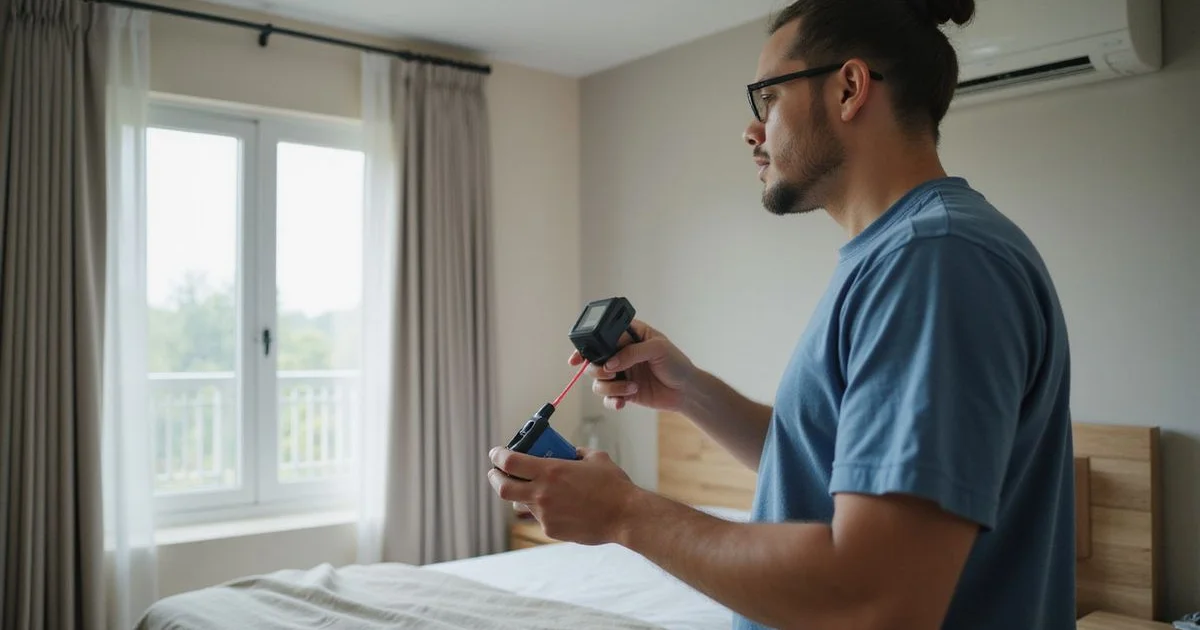
When visiting a site for an installation quote, technicians map the entire area using laser distance metres for perfect accuracy. This detailed evaluation includes:
- Measuring exact floor square metreage and ceiling height.
- Checking compass orientation for afternoon sun exposure.
- Documenting typical room occupancy and heat-generating appliances.
- Recommending a specific HP based on calculated BTU requirements.
You receive a clear, mathematical explanation of why a specific room size aircon pairing fits your needs perfectly. We never push clients toward a larger, more expensive unit if the data shows a smaller one will perform optimally.
This exact process ensures your new air conditioner delivers maximum cooling with minimal energy waste. Contact our team today to schedule your precise, data-driven assessment.
Related reading: Still deciding? You can also read our guide on How Much Does Aircon Installation Cost in Malaysia?.