
Guide
Aircon Not Turning On? Here's What to Check First
Before calling a technician, check the power, isolator, breaker and remote. Then know the safety limits — capacitor and PCB faults need a licensed visit.
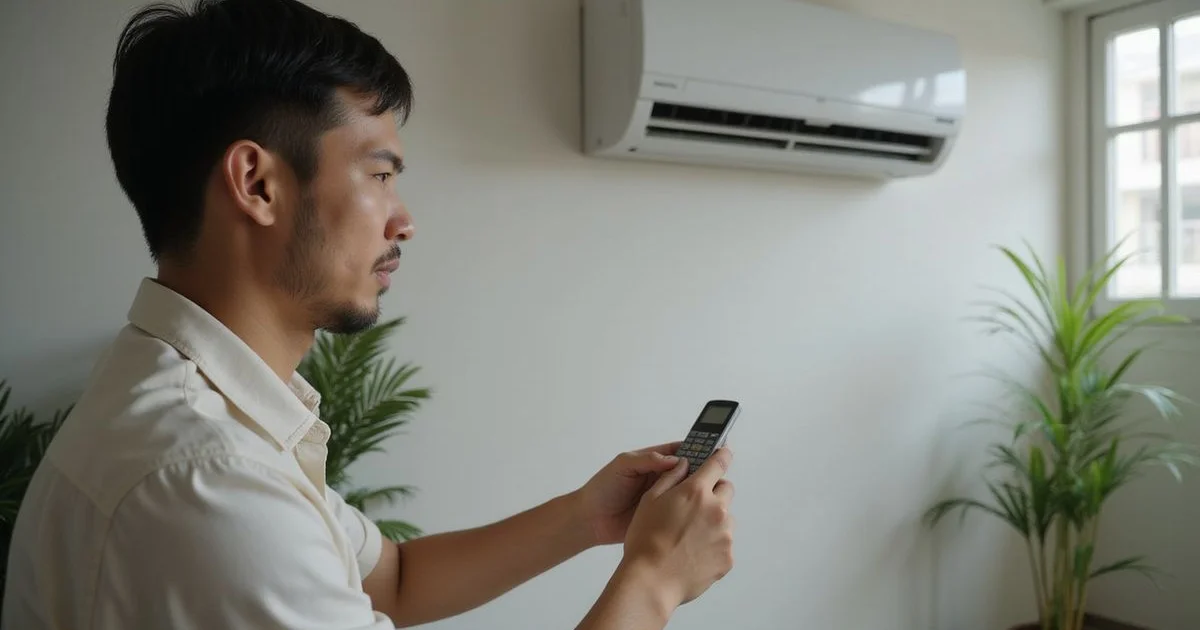
You know how a completely silent, unresponsive air conditioner can instantly ruin your day, especially during those sweltering Selangor heatwaves. We get panicked calls about an aircon not turning on almost every single morning. A dead unit often turns out to be something remarkably simple.
Running through a few basic diagnostics can save you a service call. We highly suggest running through these four safe checks before assuming a serious fault.
Just stop before opening anything beyond the front panel.
Safe checks to do yourself
The fastest way to troubleshoot a dead air conditioner is to verify the power source and the remote signal. We always advise starting with the easiest external factors first. These quick tests take less than five minutes.
1. Remote batteries
Weak batteries are the leading reason an air conditioner fails to start, even if the remote display still works. We find this is the most frequent cause by a wide margin. The remote looks fine and the indicator blinks, but the signal is simply too weak to reach the indoor unit.
Alkaline batteries have a tendency to leak in our humid Malaysian weather if left sitting for months. Our technicians often see corroded battery contacts ruining perfectly good remotes.
Replace both batteries with a fresh pair and try pressing the power button again. A quick pro-tip is to point your smartphone camera at the transmitter while pressing a button. You will see a faint purple light on your screen if the infrared signal is actually working.
2. Remote settings
Incorrect mode selections will prevent your unit from blowing cold air, leaving it seemingly unresponsive. Make sure the mode is set to “Cool”, which is usually represented by a snowflake icon. The setpoint should be at 24°C or lower, and the fan speed must be on auto or high.
A unit set accidentally to “Fan only” or “Dry” will not cool the room, even though it technically turns “on”. We regularly visit homes where a wrong setting was the only issue.
TNB actually recommends keeping your temperature between 24°C and 26°C for optimum efficiency in 2026. This simple adjustment prevents compressor overload while saving you money on your monthly bill.
3. Wall isolator switch
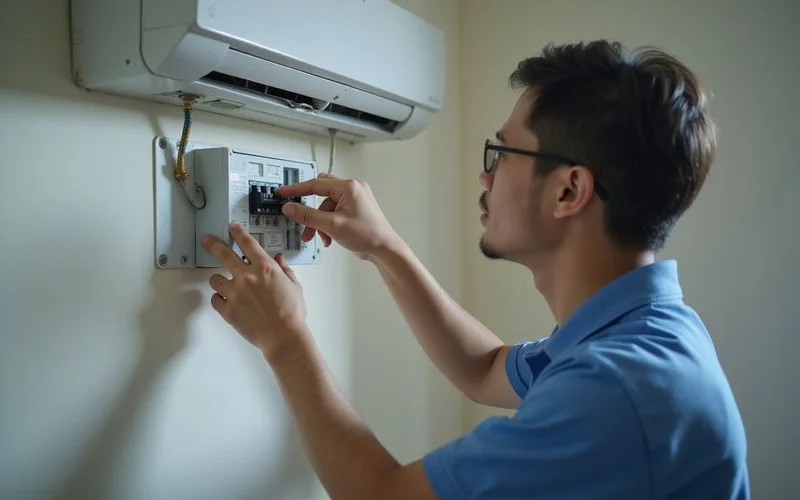
The wall isolator switch cuts electricity entirely independent of your main breaker board. You will usually find this small 20A switch on the wall near the indoor unit or occasionally out in the corridor. Standard Malaysian homes use brands like Panasonic or Schneider Electric for these safety switches.
If it has been flipped by someone cleaning, painting, or even a curious pet, the unit simply will not get power. We always check this switch first during a service visit.
Flip it firmly off and then back on to ensure a solid connection.
4. The breaker
A tripped breaker in your distribution board will completely sever the electrical supply to your air conditioning circuit. Check your consumer unit, sometimes called the DB box, for any switches pointing downwards.
Frequent lightning strikes in the Klang Valley are notorious for tripping sensitive RCCB components. Reset any tripped breakers one at a time and try firing up the aircon again.
We warn customers to pay close attention if the switch trips immediately again. That instant trip indicates a hard short circuit that requires professional attention.
When you’ve checked all that and it still won’t turn on
A unit that fails all basic power checks typically suffers from a failed capacitor, a blown control board, or severe wiring damage. Now you have successfully ruled out the easy stuff. The root cause is almost certainly a damaged internal component.
Our technicians usually encounter one of these specific failures:
| Faulty Component | Typical Symptom | Repair Action |
|---|---|---|
| Failed capacitor | Unit hums but outside fan will not spin | Common fix, requires a 35uF or 40uF replacement |
| Failed PCB (control board) | No lights, no beeps, completely dead | Needs multimeter diagnosis, common after power surges |
| Compressor electrical issue | Trips the main breaker instantly | Serious fault, requires contactor testing or replacement |
| Wiring damage | Intermittent power drops, burning smell | Involves fixing wires chewed by rats or lizards |
All of these scenarios require opening the chassis and testing electrical values with a multimeter. Replacing components correctly demands specific training and genuine spare parts.
None of these tasks fall into safe DIY territory. Aircon repair work involves lethal mains voltage and high refrigerant pressures that bite back hard when handled wrong.
We never recommend attempting to bypass internal electrical safeties. Doing so can easily destroy your entire cooling system.
Why DIY repair is risky
Opening an air conditioner exposes you to lethal 240V mains electricity and highly pressurised refrigerant gases. Aircon repair tools that look simple, like a basic multimeter or a screwdriver, are incredibly deceptive.
We strongly advise against poking around inside the chassis yourself. Working inside a modern unit exposes you to several severe hazards:
- Live mains voltage (240V): The wiring remains active even when the unit is “off” if the isolator isn’t cut.
- Stored charge: Capacitors hold a massive electrical charge long after the main power is removed.
- Flammable refrigerants: Modern units often use R32 refrigerant, which is highly pressurised and mildly flammable if you accidentally crack a joint.
- Complex schemas: Wiring layouts vary wildly by brand, model, and year of manufacture.
A licensed technician brings the right specialised tools for the job. Our experts know the specific quirks of local brands and have the experience to identify the fault quickly without making it worse. They can diagnose the problem safely while keeping your warranty intact.
What an aircon repair visit looks like
A professional service visit involves safely isolating the power, testing internal components with precise instruments, and replacing the exact faulty part. When you book us for a “won’t turn on” call in Cheras or Selangor, we follow a strict diagnostic procedure.
We rely on clear communication and transparent pricing at every step. This is exactly what happens when our team arrives:
- Confirm the isolator and DB box breaker situation first.
- Open the unit safely with the power completely isolated.
- Test the capacitor, internal fuses, and PCB using a professional Fieldpiece multimeter.
- Identify the exact failed component causing the blackout.
- Quote the repair transparently before any parts change hands.
- Test the unit fully to confirm stable performance before leaving.
Most no-power calls are resolved in a single, efficient visit. Heavier faults sometimes need a return trip with a specific branded part.
We always tell you upfront if your repair requires a special order. Transparency guarantees you never face surprise charges on your final invoice.
If your aircon not turning on has left you sweating, reach out to schedule a diagnostic visit.
Let us get your cooling system back online safely today.
Related reading: Still deciding? You can also read our guide on Aircon Error Codes Explained: Daikin, Panasonic & Acson Blinking Lights.