
Guide
Aircon Repair vs Replacement: When Is It Time to Replace?
Age, refrigerant type, repair cost ratio and energy efficiency all matter. Here's how we weigh repair vs replacement honestly, without pushing new sales.
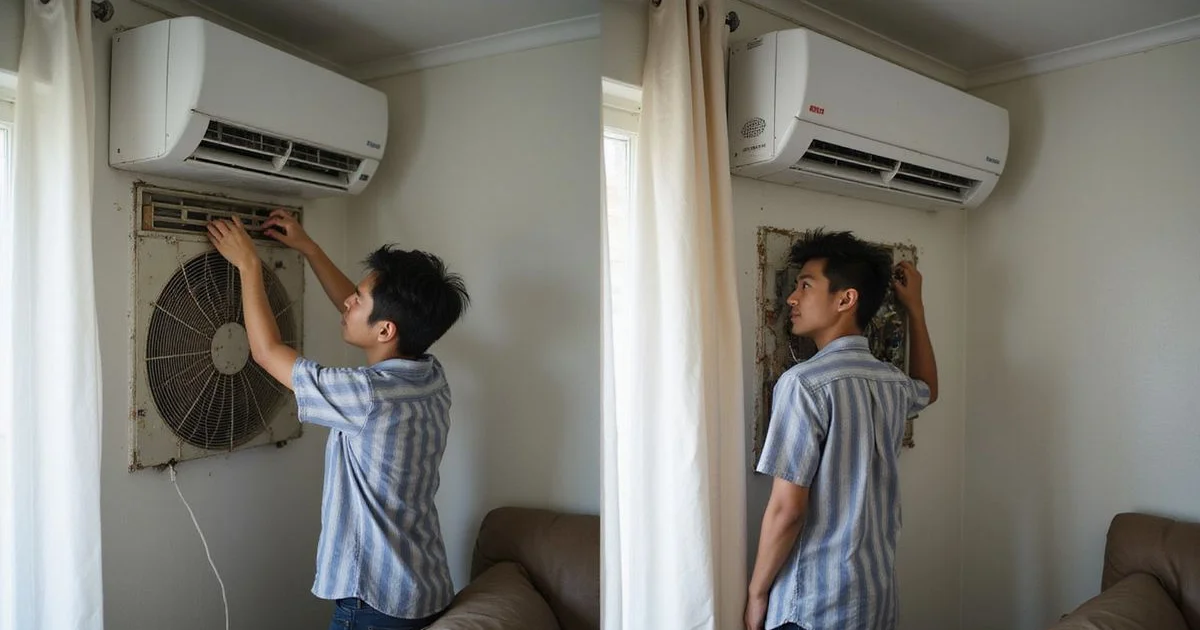
The honest framework for deciding
Facing a malfunctioning cooling system often leaves property owners wondering if they should authorize an aircon repair or replace the unit entirely. You need clear data to make a smart financial choice, rather than guessing based on frustration.
We evaluate every failing unit using a strict set of criteria to remove the guesswork. The assessment breaks down into four critical areas:
- Age of the unit
- Refrigerant type
- Cost of the repair vs cost of a new unit
- Efficiency and TNB energy bills
Our technicians apply this identical framework during every service call to provide a straightforward recommendation. Transparency is easy to maintain since our rates for both repairs and installation remain strictly competitive.
Let’s examine the specific details that dictate the most logical next step.
Factor 1: Age
Age is the first metric to review when asking, “should I replace my aircon?”. Well-maintained air conditioners in Malaysia run reliably for eight to twelve years.
We find that local humidity and daily usage accelerate wear on major components. The Printed Circuit Board (PCB) and compressor often show stress marks around the ten-year mark.
Our repair history shows that major part failures escalate sharply after a decade. A burnt compressor replacement costs anywhere from RM800 to RM2,500 based on horsepower. This hefty price makes fixing an old unit a poor long-term investment. Here is the timeline we use to advise local property owners:
- Under 5 years: Fixing the unit almost always wins, as parts are often still under manufacturer warranty.
- 5 to 8 years: The decision depends heavily on the specific component failure and system condition.
- 8 to 10 years: Evaluate the situation carefully, as the type of cooling gas used plays a massive role.
- Over 10 years: Lean heavily in favour of a new system unless the equipment operates in unusually pristine condition.
Factor 2: Refrigerant type
The type of cooling gas inside your system is a massive swing factor that dictates long-term viability. We always check the specification sticker first to understand the replacement timeline. The Malaysian Department of Environment (DOE) strictly enforces phase-out schedules for older ozone-depleting gases. This ongoing transition directly impacts the aircon repair vs replace calculation.
Three primary categories of refrigerants dominate the current local market:
- R32: This modern, highly efficient gas is the 2026 standard and is widely available. Fixing a unit that runs on R32 makes excellent financial sense.
- R410A: Found in mid-age systems, this gas is still supported but faces future manufacturing restrictions. Proceeding with a fix is generally acceptable for minor issues.
- R22: This older gas is being systematically phased out globally, causing local stocks to shrink rapidly.
Our service teams report that finding virgin R22 for major leak repairs is increasingly difficult and expensive. If your equipment uses R22 and the aircon repair requires extensive gas work, the math points firmly to getting a new unit. Upgrading to an R32 model avoids the rising costs of obsolete supplies.
Factor 3: Repair cost vs replacement cost
Applying the standard “50 percent rule” provides a clear mathematical boundary. We generally advise that buying a new unit is the smarter move if the fixing expense exceeds half the replacement cost. This threshold can stretch to 60 or 70 percent for newer equipment still under warranty.
Our technicians frequently encounter customers struggling to compare these numbers accurately. The final installation price must factor in the hardware, the labour, and the standard RM250 to RM400 piping charges common across Selangor. Consider this real-world example of a 9-year-old 1.5HP non-inverter model facing a major breakdown.
We can break down the financial comparison to show why a new purchase often wins.
| Option | Required Action | Estimated Cost (RM) | Future Outlook |
|---|---|---|---|
| Fix Existing | Replace blown compressor | RM900 | High risk of PCB or fan motor failure next |
| Buy New | Install 1.5HP R32 Inverter | RM2,800 | 5-year warranty with zero near-term repair risk |
The RM900 quote sits at roughly 32 percent of the new installation price. We would still lean in favour of recommending a completely new system despite the cost falling below the 50 percent rule. The advanced age of the hardware means another costly component will likely fail soon.
Factor 4: Efficiency
Daily operating costs change the entire financial equation over a five-year period. We remind customers that keeping an inefficient system running is like paying a hidden tax. Tenaga Nasional Berhad (TNB) implemented new tariff structures under Regulatory Period 4, penalizing heavy electricity consumers.
Our energy consumption tracking reveals stark differences between older and modern cooling technologies:
- Non-Inverter Units: Pull constant maximum wattage, costing RM130 to RM160 monthly for a standard 1.5HP model running eight hours nightly.
- 5-Star Inverter Units: Adjust compressor speeds dynamically, dropping the same monthly usage cost down to roughly RM90 to RM110.
- Real-World Savings: The 30 to 40 percent power reduction easily keeps thousands of Ringgit in your bank account over the equipment’s life span.
This monthly reduction generates massive savings over the years. We calculate that upgrading a heavily used bedroom unit saves you RM1,500 to RM2,500 in TNB bills over five years. The efficiency gain alone covers the premium price of buying an inverter model.
What we honestly recommend
We frequently advise customers that their old equipment is absolutely worth fixing. A moderate bill, a current refrigerant type, and a solid physical condition make keeping your current unit the practical choice.
Our service protocol dictates that we also tell people when discarding the hardware makes financial sense. The final choice always remains in your hands, but you will have the data needed to decide confidently.
You can expect the following from every service call:
- Straightforward pricing for all gas top-ups and replacement parts.
- Clear documentation detailing the exact component failure.
- Honest advice without aggressive sales pressure.
We view our job as providing accurate diagnostics and clear context. Transparent communication is exactly how the team has maintained a 4.9-star reputation across more than 550 Google reviews. Contact our Cheras office today to schedule a thorough diagnostic check, and let us help you find the most cost-effective solution.
Related reading: Still deciding? You can also read our guide on Aircon Error Codes Explained: Daikin, Panasonic & Acson Blinking Lights.